Twisted Duck Sex
In the sensitive matters of courtship and reproduction, birds seal it with a kiss. No, not a peck with their bills. Birds do it instead with the cloaca — the rear-end opening in males and females through which waste and either sperm or eggs must pass. In an acrobatic union lasting only a second or so, birds join in a “cloacal kiss.”
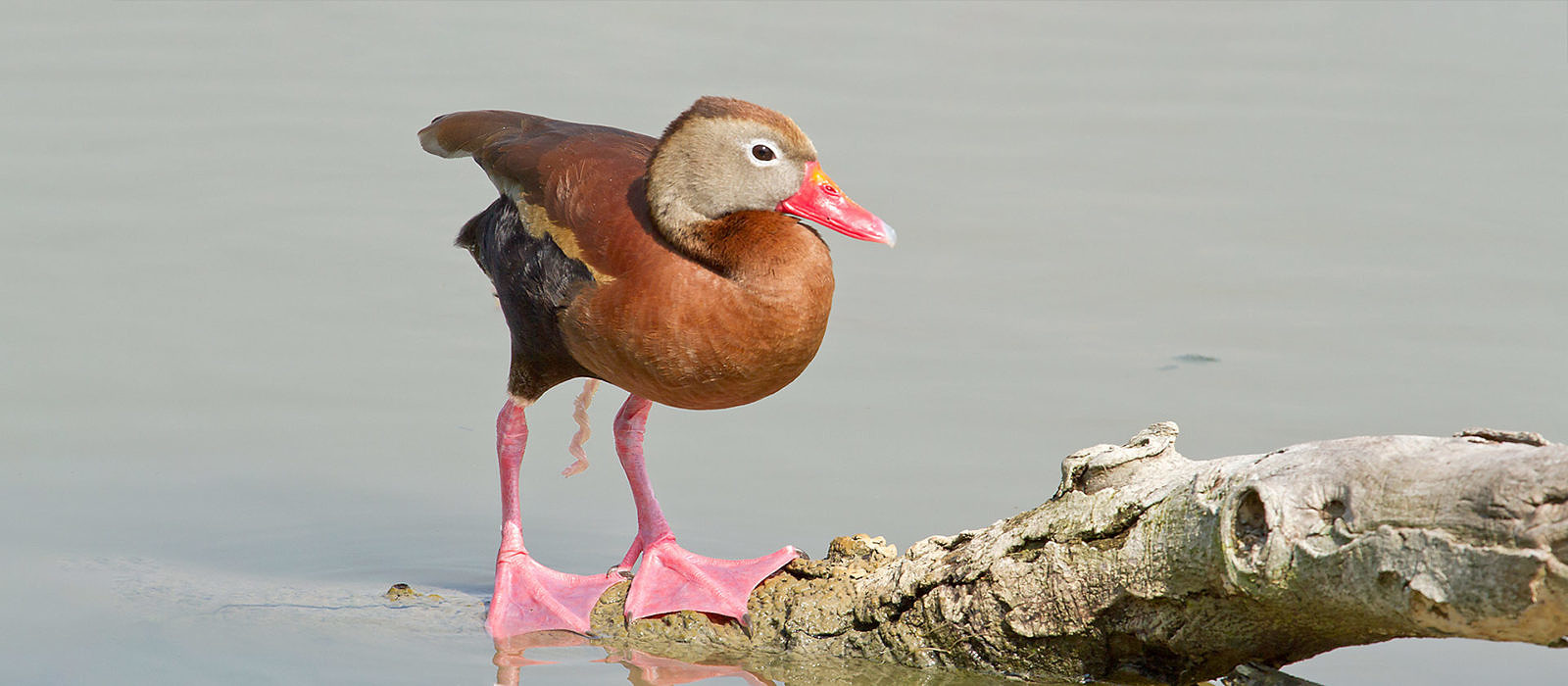
Among ducks, however, there is no kiss. Not even dinner and a movie. Male ducks (drakes) are among the few birds with a penis. No ordinary organ, the duck penis is shaped like a corkscrew, spiraling up to 20 centimeters in length. (And if you are already finding this hard to believe, or even uncomfortable, have another look at my photo, above, of a Black-bellied Whistling Duck. Warning: this blog post gets even more graphic from here.)
Rather than engaging in a cloacal kiss, male ducks seize upon females in what biologists call “forced copulation,” but by any other name amounts to sexual assault. As he overtakes a female, the drake extends his penis — in a counter-clockwise route — into her reproductive tract. Like the cloacal kiss (but only less mutual) this extension happens fast, no more than a second or so, in what those tactful biologists call “explosive eversion.”
As it turns out, there’s some interesting evolution going on here. Actually, all evolution is interesting, but this amounts to a kind of evolutionary war of the sexes. Evolution has driven the female’s reproductive tract to spiral in the opposite direction of the male’s penis. And it could be a form of defense on her part to the male’s behavior.
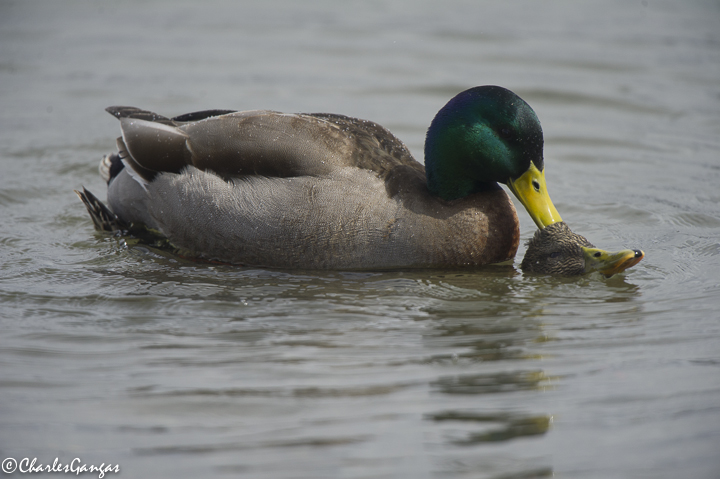
A drake Mallard and a hen (nearly submerged) photographed in Newfoundland by Charles Gangas, who adds: “It didn’t look fun for her.”
If a female is receptive to a particular male, with her body prone, her tail lifted high, her cloaca exposed and her muscles relaxed, the contours of her reproductive tract present no major barriers during copulation. After all, most ducks mate for life. Females do have a reproductive stake in the bonds they form during courtship.
But when a female is confronted with an unwelcome male, her reproductive tract can makes copulation more difficult for him. Not only does it spiral in the opposite direction of his penis, it is outfitted with various cul-de-sacs. So although she may be unable to escape his aggressions, and even his explosive eversion, she can do something more fateful: she prevents fertilization. Her contrary reproductive tract forms a literal and genetic dead end for the male. Rejection times two.
At least that was the hypothesis.
But how can a biologist test this notion of screwy duck sex and evolution? It’s not as if they can, like Masters and Johnson, stand around with clipboards watching ducks do it. So Patricia Brennan, an evolutionary biologist at Yale University and her colleagues, including my pal Rick Prum, employed duck sex toys. They encouraged captive male Muscovy Ducks to, well, um, er, perform explosive eversion into glass tubes that were twisted into different shapes. And in each case the researchers video-recorded the event to measure the “functional response to different mechanical challenges.” That’s science parlance for determining if he can “go the distance” along her countervailing routes.
In their paper,[1] published in a journal called Proceedings of the Royal Society B (for biological sciences), they concluded that, yes, what’s going on here (besides some kinky video) is an example of coevolution — males evolving one physical characteristic (phenotype) and females a counter-phenotype that suggests conflict rather than cooperation, even in sex. It is in some ways like birth control, or fertilization control, but on an evolutionary scale. And it illustrates that reproduction is rarely simple, hardly a fairy-tale of courtship, cooperation and copulation in order to expand the genome.
In formulating his theories on evolution, Charles Darwin most certainly recognized the role of conflict and “the struggle for existence.” Only now, however, are biologists discovering more about “sexual conflict” — the ramifications of males and females not sharing equally the burdens and benefits of reproduction, and how each has evolved accordingly and with various strategies.
Forced copulations can result in injury or even death in a female duck — or perhaps abandonment by her preferred mate. These encounters can also prevent her from going about her business feeding herself, for example, or avoiding predators. So she has good reason, the hypothesis goes, to evolve with some sort of defense to unwanted males.
The female’s contrary reproductive tract could have evolved as a form of autonomy.
It it unlikely that this female defense evolved by natural selection to limit these direct costs of forced copulations because the female “vaginal morphology,” as the biologists call it, does not prevent aggression on the part of males. The female’s contrary reproductive tract could have evolved as a form of autonomy — a reassertion of her own mating autonomy by preventing the sperm from an unwelcome male from fertilizing her eggs.
Among Darwin’s oversights was that he did not recognize the complexity of copulation, how sexual selection and these kinds of contrivances may be hidden, or how females may even evolve other ways to prevent — even control — fertilization after copulation. After all, genetics matter — a lot.
Darwin did recognize, however, that there is more to sex than blind reproduction.
“The courtship of animals,” he wrote in Descent of Man and Selection in Relation to Sex, “is by no means so simple and short an affair as might be thought.”
In other words, it’s complicated. It can also be screwy and twisted.
References:
[1] Patricia L. R. Brennan, C. J. Clark, R. O. Prum. 2009. Explosive eversion and functional morphology of the duck penis supports sexual conflict in waterfowl genitalia. Proc. R. Soc. B May 7, 2010 277:1309-1314; published online before print December 23, 2009, doi:10.1098/rspb.2009.2139

That’s a Black-bellied Whistling Duck.
what kind of duck is the front cover?
You’re most welcome, Bernie!
Love it, thank you.
TMI when it comes to nature? No way! 🙂
I think this is more info than I need to know!
Fascinating research nonetheless.
Sue Wetmore
Well, as it turns out, this is true, which, of course, does not excuse Todd Aiken from being an idiot. It even caused a bit of controversy again recently: http://www.politifact.com/truth-o-meter/statements/2013/mar/22/tweets/federal-government-funding-study-duck-penises/
So, _when it comes to ducks_, “if it’s a legitimate rape, the female body [actually DOES have] ways to try to shut that whole thing down”! Phenomenal. Maybe this could clear up any remaining confusion within the mind of former senate candidate Todd Akin?